Notes
Source: U.S. Bureau of Economic Analysis
Release: Personal Income and Outlays
Units:
Frequency:
Notes:
BEA Account Code: DPCERG The Personal Consumption Expenditures Price Index is a measure of the prices that people living in the United States, or those buying on their behalf, pay for goods and services. The change in the PCE price index is known for capturing inflation (or deflation) across a wide range of consumer expenses and reflecting changes in consumer behavior. For example, if the price of beef rises, shoppers may buy less beef and more chicken. The PCE Price Index is produced by the Bureau of Economic Analysis (BEA), which revises previously published PCE data to reflect updated information or new methodology, providing consistency across decades of data that's valuable for researchers. They also offer the series as a Chain-Type index, as above. The PCE price index is used primarily for macroeconomic analysis and forecasting. The PCE Price index is the Federal Reserve’s preferred measure of inflation. The PCE Price Index is similar to the Bureau of Labor Statistics' consumer price index for urban consumers. The two indexes, which have their own purposes and uses, are constructed differently, resulting in different inflation rates. For more information on the PCE price index, see: U.S. Bureau of Economic Analysis, Guide to the National Income and Product Accounts of the United States (NIPA) U.S. Bureau of Economic Analysis, Personal Consumption Expenditures Price Index U.S. Bureau of Economic Analysis, Prices & Inflation U.S. Bureau of Labor Statistics, Differences between the Consumer Price Index and the Personal Consumption Expenditure Price Index
Suggested Citation:
U.S. Bureau of Economic Analysis, Personal Consumption Expenditures: Chain-type Price Index [PCEPI], retrieved from ALFRED, Federal Reserve Bank of St. Louis; https://alfred.stlouisfed.org/series?seid=PCEPI, December 16, 2025.
Source: U.S. Bureau of Labor Statistics
Release: Employment Situation
Units:
Frequency:
Notes:
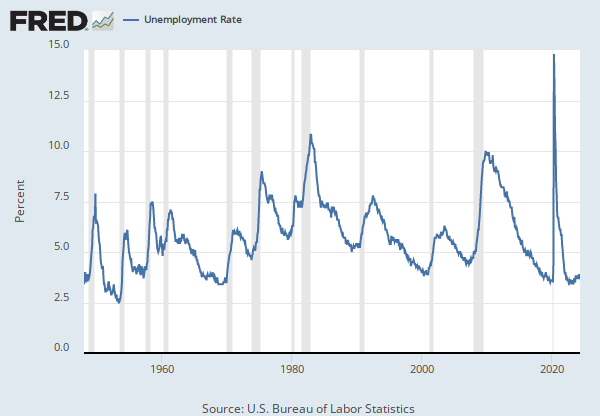
The unemployment rate represents the number of unemployed as a percentage of the labor force. Labor force data are restricted to people 16 years of age and older, who currently reside in 1 of the 50 states or the District of Columbia, who do not reside in institutions (e.g., penal and mental facilities, homes for the aged), and who are not on active duty in the Armed Forces.
This rate is also defined as the U-3 measure of labor underutilization.
The series comes from the 'Current Population Survey (Household Survey)'
The source code is: LNS14000000
Suggested Citation:
U.S. Bureau of Labor Statistics, Unemployment Rate [UNRATE], retrieved from ALFRED, Federal Reserve Bank of St. Louis; https://alfred.stlouisfed.org/series?seid=UNRATE, December 16, 2025.
Release Tables
Employment Situation
- Monthly, Seasonally Adjusted (population data is not adjusted for seasonal variation; not seasonally adjusted version used)
- Table A-10. Selected unemployment indicators, Seasonally adjusted: Monthly, Unemployment Rates
- Table A-15. Alternative measures of labor underutilization: Monthly, Seasonally Adjusted
Personal Income and Outlays
Related Data and Content
Data Suggestions Based On Your Search





Content Suggestions










Other Formats
Personal Consumption Expenditures: Chain-type Price Index
Annual, Not Seasonally Adjusted Quarterly, Seasonally AdjustedUnemployment Rate
Monthly, Not Seasonally AdjustedRelated Categories
Consumer Price Indexes (CPI and PCE)
Prices
Price Indexes & Deflators
National Income & Product Accounts
National Accounts
Categories
Unemployment Rate
Current Population Survey (Household Survey)
Population, Employment, & Labor Markets
Releases
Tags
Chained
Headline Figure
Personal Consumption Expenditures
Consumption Expenditures
Consumption
Personal
National Income and Product Accounts
Inflation
Bureau of Economic Analysis
Price Index
Indexes
Seasonally Adjusted
Price
Monthly
Nation
Public Domain: Citation Requested
United States of America
Labor Underutilization
Civilian
16 Years +
Labor
Current Population Survey (Household Survey)
Unemployment
Rate
Bureau of Labor Statistics